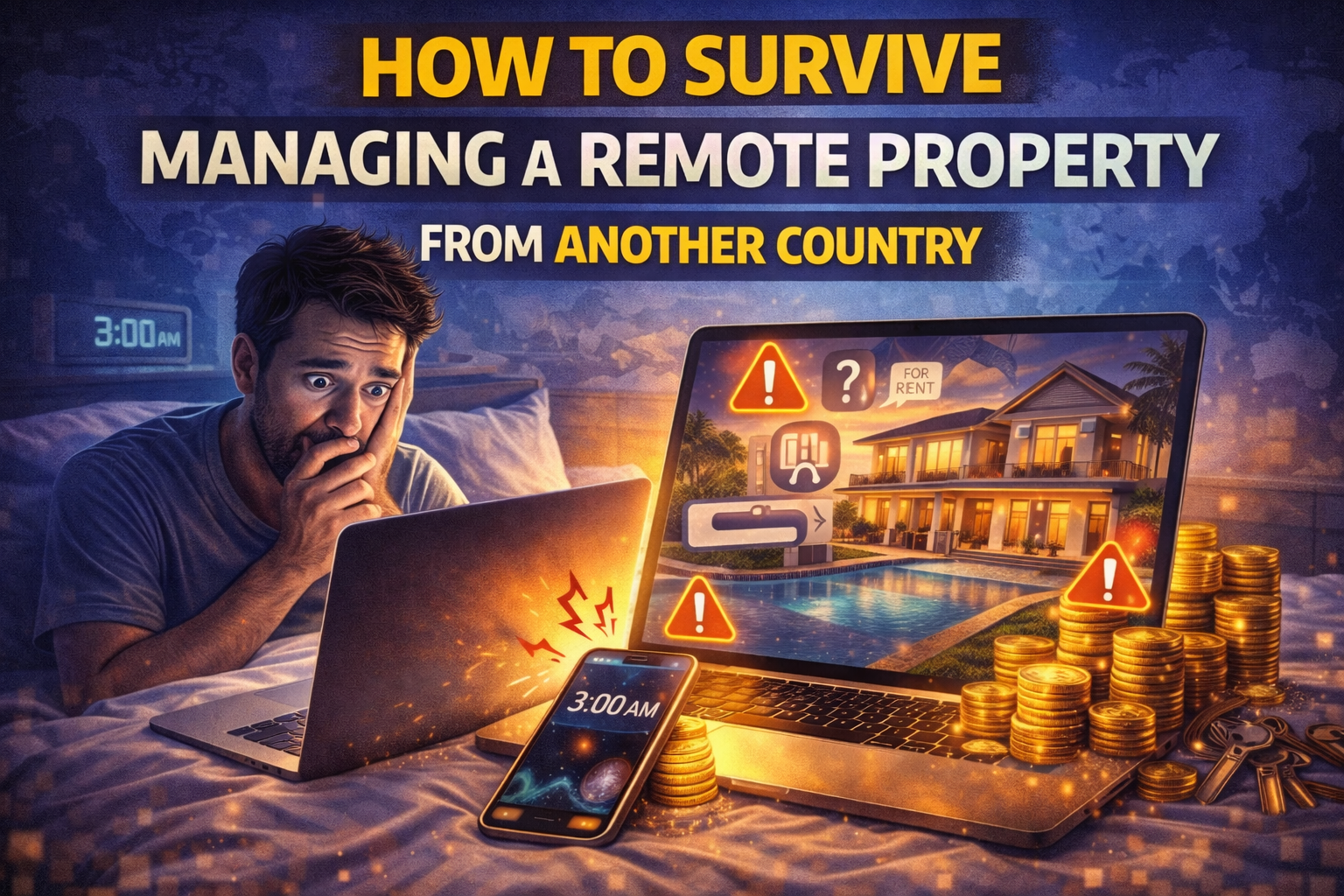
Managing a remote property while living abroad sounds stressful, but it doesn’t have to be. Learn the tools, teams, and tactics to keep your rental profitable from anywhere.
Table of Contents
It starts with a phone call. It’s always a phone call.
I remember sitting in a bistro in Paris, enjoying what was arguably the best croissant of my life, when my phone buzzed. It was 2:00 PM in France, but 4:00 AM back in Chicago. My tenant’s water heater had just exploded, flooding the basement. In that moment, the romantic dream of being an international investor clashed violently with the reality of managing a remote property.
If you are reading this, you are probably in the same boat. Maybe you moved for work, maybe you retired to a sunny beach, or maybe you just realized the numbers work better in a market 5,000 miles away. Whatever the reason, the anxiety is real. Can you really trust people to look after your biggest asset when you aren’t there to drive past it?
The short answer is yes. But you have to stop thinking like a landlord and start thinking like a CEO. When you manage a remote property, you aren’t the guy plunging the toilet; you’re the guy hiring the guy who plunges the toilet. It’s a mindset shift that changes everything.
The “Boots on the Ground” Dilemma
The first rule of successful remote property management is accepting that you cannot do it alone. I tried the “DIY from a distance” method once. I had a trusted neighbor who promised to keep an eye on things. That worked great until the neighbor went on vacation the same week the furnace died.
You need a professional layer between you and the chaos. For most expats, this means hiring a property management company. Yes, it eats into your cash flow—usually 8% to 12% of the monthly rent—but think of it as insurance for your sanity. A good manager handles the late-night calls, the tenant screening, and the legal evictions if things go south.
However, if you are determined to self-manage a remote property to save that fee, you need a “Frankenstein” team. You need a reliable handyman, a cleaner, and a plumber who all have WhatsApp and your credit card on file.
Tech is Your Best Friend (and Worst Enemy)
Technology has made owning a remote property infinitely easier than it was ten years ago. Back then, you had to wait for paper checks in the mail. Now, if you aren’t automating rent collection, you’re doing it wrong.
Smart Home Ecosystems
I insist that every remote property I own has a smart lock. Why? because physical keys are a liability. If a tenant gets locked out, I can unlock the door from my phone in Tokyo. If a contractor needs to fix the AC, I can generate a temporary code that expires in two hours.
But don’t go overboard. I once installed a high-end smart thermostat that required a Wi-Fi reset every time the power flickered. My tenant hated it, and I spent hours troubleshooting over Facetime. Keep the tech simple and robust.
Digital Paper Trails
When you are thousands of miles away, documentation is your shield. Use cloud-based platforms for everything. Lease agreements should be signed digitally using tools like DocuSign. Maintenance requests should go through a portal, not a text message. This creates a timestamped history that is invaluable if you ever end up in a dispute over a security deposit.
The Time Zone Math
One of the most overlooked aspects of running a remote property is the time difference. If you are in Australia and your rental is in New York, your working hours are completely flipped.
You have to set boundaries. I tell my tenants: “I am available via email within 24 hours. If it is a life-threatening emergency (fire, flood, blood), call 911. If it is a maintenance emergency, call this specific contractor.”
If you don’t set these expectations, you will wake up to texts about a dripping faucet at 3 AM. Owning a remote property shouldn’t cost you your sleep.
Financial Buffers: The “Sleep Well at Night” Fund
When you are local, a broken window is an annoyance. When you are abroad, it feels like a crisis because you can’t see the damage. To mitigate this panic, your financial reserves need to be higher for a remote property.
I recommend keeping at least six months of expenses in a liquid account specifically for that property. This isn’t just for repairs; it’s for vacancies. If your tenant moves out, it might take longer to turn the unit over because you aren’t there to nag the painters. A healthy “maintenance fund” prevents you from making desperate decisions, like accepting a marginal tenant just to stop the bleeding.
Managing the “Out of Sight” Anxiety
It is easy to become paranoid when you haven’t seen your investment in a year. Is the lawn dead? Did they paint the walls black?
To combat this, schedule routine inspections. If you have a property manager, make them send you video walkthroughs, not just photos. Photos can be framed to hide the hole in the drywall; a video shows the truth. If you are self-managing your remote property, pay a local inspector or a real estate agent a flat fee to do a walkthrough once every six months. It’s worth the $150 for the peace of mind.
Strategies for Maintaining High Occupancy
Vacancy is the silent killer of returns. When you own a remote property, filling a vacancy is harder because you can’t just drive over to host an open house.
- Price Aggressively: I’d rather rent my unit for $50 less than market value and have it filled in a week than hold out for top dollar and have it sit empty for two months.
- Virtual Tours: Invest in a high-quality 3D tour (like Matterport). This allows prospective tenants to “walk” the unit without you being there.
- Long-Term Tenants: Incentivize stability. I’ve offered tenants a discount on their 13th month if they renew for a second year. Turnover costs on a remote property are brutal, so keeping a good tenant is paramount.
Legal and Tax Implications for Expats
I am not a CPA, and I don’t play one on the internet, but you need to understand the tax web you are spinning. If you are an American owning rental property abroad, or a foreigner owning in the US, the tax man wants his cut.
For example, non-US residents owning US property are often subject to FIRPTA withholding rules. Conversely, if you are a US citizen with a remote property in Spain, you have to report that income to both the Spanish authorities and the IRS.
Ignorance is not a defense. Get a cross-border tax specialist. Yes, they are expensive. No, you cannot afford to skip this.
When to Sell
There comes a time in every investor’s life when a remote property just isn’t worth the headache anymore. Maybe the neighborhood is declining, or maybe the local laws have become too tenant-friendly.
Don’t fall in love with the brick and mortar. If the asset is causing you stress every week, sell it. There is no shame in 1031-exchanging that remote property into a REIT or a syndication where someone else does the heavy lifting. Real estate should serve your life, not the other way around.
The Human Element
Despite all the apps and contracts, real estate is a people business. Treat your tenants with respect. If you are a ghost landlord who never fixes anything, they will not care about your house. But if you are responsive and fair, they will often act as the guardians of your remote property.
I send my long-term tenants a small gift card during the holidays. It costs me $50, but it buys me a year of goodwill. When the fence blows down in a storm, they are the ones who will go out in the rain to prop it up before calling me. That relationship is your true safety net.
FAQ Section
1. Is it better to hire a property manager or self-manage a remote property? For 90% of people, hiring a manager is better. The 8-10% fee pays for itself by avoiding legal mistakes, shortening vacancy periods, and handling late-night emergencies. Self-managing is only viable if you have a very reliable network of local contractors.
2. How do I handle tenant screenings from another country? Use online screening services like TransUnion SmartMove or Cozy. These platforms run credit checks, criminal history, and eviction reports automatically. Never rely on a “gut feeling” over the phone; rely on the data.
3. What happens if I need to evict a tenant while I’m abroad? You will need to hire a local real estate attorney to handle the eviction. Do not try to navigate eviction courts remotely or represent yourself via Zoom. It is a strict legal process, and one paperwork error can restart the whole timeline.
4. How do I collect rent for my remote property? Avoid physical checks. Use digital payment platforms like Zelle, Venmo (if applicable), or dedicated property management software like Buildium or TurboTenant. These create an automatic digital paper trail for tax season.
5. Should I visit my remote property in person? Ideally, yes. Try to visit once a year to inspect the condition of the capital items (roof, HVAC, foundation). If you can’t go, hire a professional home inspector to do a “check-up” report for you.
Conclusion
Managing a remote property from another country is a balancing act of trust and verification. It requires you to let go of micromanagement and embrace systems. It will test your patience, and occasionally your wallet, but it also opens the door to global diversification and freedom.
Just remember: the goal isn’t to have a perfect house; it’s to have a profitable business. Equip your remote property with the right tech, build your team, and then go back to enjoying that croissant. You’ve earned it.