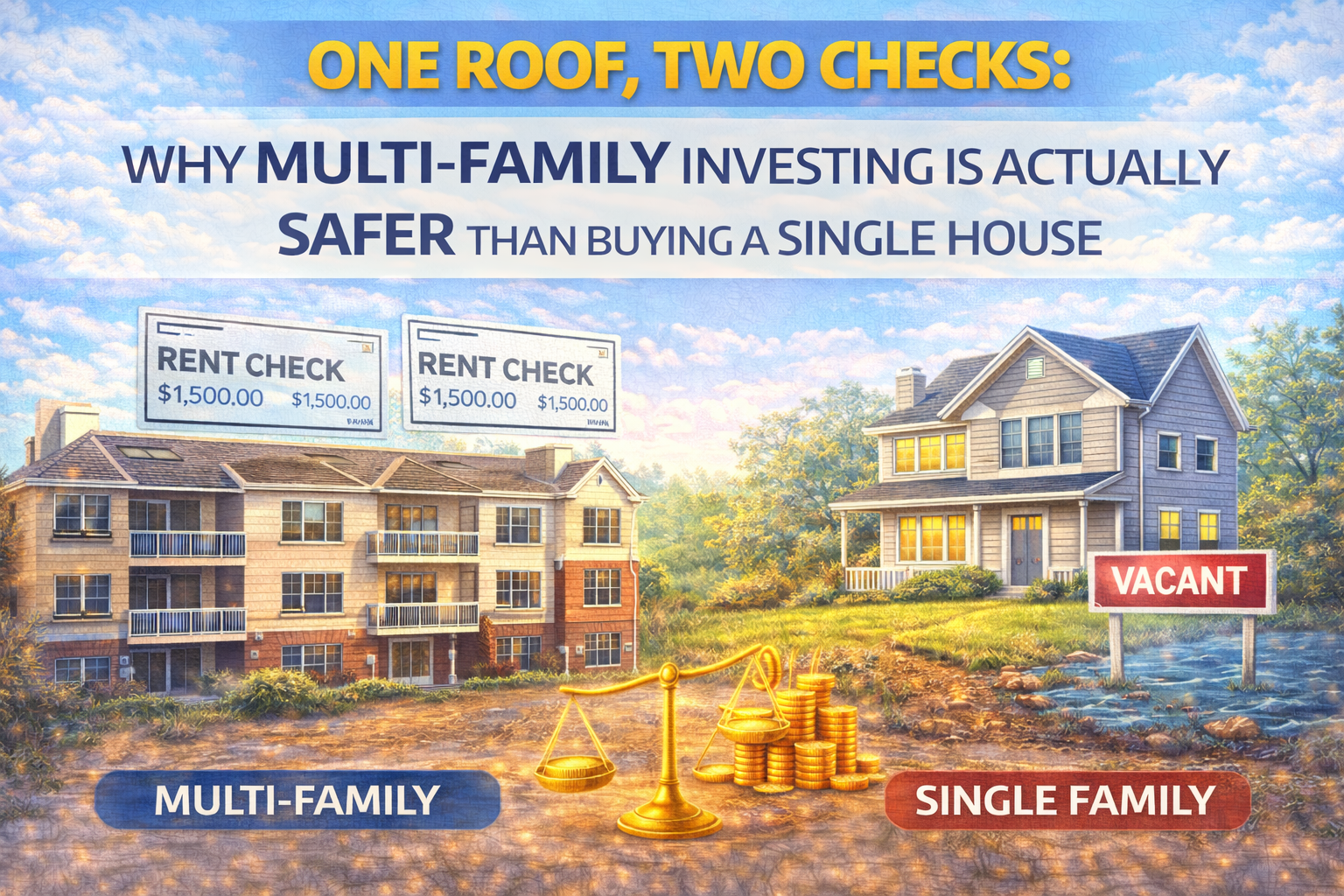
terrified of vacancy? Discover why multi-family investing in a duplex or triplex is the safest bet for beginners. Lower risk, higher cash flow, and better sleep.
Table of Contents
I still remember the first time I tried to convince my mom that buying a big, beautiful suburban house was a bad investment for a beginner. She looked at me like I had three heads. “But it has a white picket fence!” she argued. “It’s safe!”
I had to explain to her that in the world of real estate, “safe” doesn’t mean a manicured lawn or a gated community. Safe means cash flow. Safe means redundancy. And that is exactly why multi-family investing—specifically buying a duplex, triplex, or fourplex—is mathematically safer than dumping your money into a single-family rental.
If you are a new investor standing at the crossroads, wondering whether to buy a condo or a small apartment building, you need to understand the power of “The Power of Two.” When you have one tenant in a single-family home and they move out, your income drops to zero. That is 100% vacancy. It’s a financial heart attack. But with multi-family investing, if one tenant leaves, the other is still paying the mortgage. That isn’t just a safety net; it’s a business model that lets you sleep at night.
The Math of “Redundancy”
Let’s strip away the emotion and look at the numbers. The biggest fear for any landlord is the dreaded V-word: Vacancy.
In a single-family home, your vacancy rate is binary. You are either making money, or you are losing money. There is no middle ground. If it takes you two months to find a new tenant, that is two months of mortgage payments coming directly out of your savings account.
In multi-family investing, you have built-in insurance. If you own a duplex and one side goes dark, the rent from the other side usually covers the operating expenses and at least part of the debt service. You might not be making a profit that month, but you aren’t bleeding cash, either. This risk mitigation is the cornerstone of why experienced investors prefer multi-family investing over single doors.
Economies of Scale: Buy Once, Paid Twice
Here is another secret about multi-family investing that people often overlook: it’s cheaper to run.
Think about the roof. If you own two separate single-family houses, you have to maintain two separate roofs, two separate driveways, and pay two separate insurance policies. But with a duplex, you have one roof covering two income streams.
You are getting double the rental income for roughly the same amount of structural maintenance. This concept is called economies of scale. When you send a plumber out to fix a leak in Unit A, and he can quickly check the water heater in Unit B while he’s there, you are saving on trip charges. These little efficiencies compound over time, making multi-family investing significantly more profitable per square foot than its single-family counterpart.
The “House Hacking” Superpower
If you are just starting out, multi-family investing opens the door to the holy grail of real estate strategies: house hacking.
This is where you buy a small multi-family property (2-4 units), live in one unit, and rent out the others. Because you are an owner-occupant, you qualify for residential loans with incredibly low down payments, like the FHA loan (3.5% down) or even VA loans (0% down).
I’ve seen clients live in a triplex where the rent from the other two units covered their entire mortgage and put $200 in their pocket every month. They were literally getting paid to live in their own house. You simply cannot do that with a standard single-family home. It is the most accessible entry point into multi-family investing for anyone with less than $20,000 in the bank.
Financing: It’s Easier Than You Think
A common misconception is that multi-family investing requires “commercial” financing with scary terms and 30% down payments.
Here is the truth: as long as the property has four units or fewer, banks treat it exactly the same as a single-family house. It is considered “residential” real estate. You get the same 30-year fixed rates. In fact, lenders love multi-family investing deals because they can use the potential rental income from the other units to help you qualify for the loan.
If your personal income is a bit tight, the building’s income helps lift the load. It’s a symbiotic relationship that makes multi-family investing accessible to people who might not qualify for a luxury single-family home on their salary alone.
Dealing with the “Tenant Factor”
I won’t sugarcoat it—multi-family investing does come with more human drama. When you have two families living closer together, sharing a wall or a ceiling, you are going to get noise complaints. You might have to mediate disputes about who parked in whose spot or whose dog barked at 3 AM.
Managing a duplex requires a bit more active property management than a standalone house where the tenant feels like they own the place. However, the trade-off is worth it. I’d rather deal with a noise complaint on a Tuesday than a foreclosure notice on a Friday because my single-family tenant stopped paying rent.
The Valuation Game: Income vs. Comps
When you sell a single-family home, the price is dictated by what the neighbors sold for (comparable sales, or “comps”). It’s emotional. It depends on whether the kitchen is trendy or the curb appeal is nice.
Multi-family investing is different. While small multi-families (2-4 units) are still influenced by comps, they are also valued heavily on their income potential. Investors buy them for the cap rate (capitalization rate). This means you can force appreciation not just by painting the walls, but by raising the rents.
If you increase the Net Operating Income (NOI) of your building, you mathematically increase its value. You have more control over your equity in multi-family investing because you are selling a business, not just a lifestyle.
Why 2026 is the Year to Pivot
As we look at the current market, single-family home prices in many metro areas have hit a ceiling. Affordability is stretched. This makes multi-family investing even more attractive.
People will always need a place to live. During economic downturns, people often downsize from expensive single-family homes into more affordable apartments or duplexes. Multi-family investing tends to be more recession-resistant because it serves the “need” segment of the market rather than the “want” segment.
Link to BiggerPockets Guide on Multi-Family Strategy
The “Exit Strategy” Flexibility
Finally, multi-family investing gives you more ways to get out.
- Sell to an Investor: Other investors are always hungry for cash-flowing assets.
- Sell to a House Hacker: There is a huge demand from young buyers looking to offset their mortgage.
- Condo Conversion: In some markets, you can legally split the duplex and sell each unit individually as condos for a massive profit.
A single-family home usually only has one buyer pool: a family who wants to live there. By engaging in multi-family investing, you are widening your pool of future buyers.
FAQ Section
1. Is a duplex considered commercial real estate? No. A duplex (2 units), triplex (3 units), or fourplex (4 units) is considered residential real estate. This allows you to use standard conventional or government-backed loans. Multi-family investing only enters the “commercial” realm when you buy a building with 5 or more units.
2. Do I have to live in the property? Not necessarily. You can buy a multi-family property purely as an investment and rent out all the units. However, if you want the best loan terms (low down payment), you usually need to occupy one of the units for at least 12 months.
3. Is multi-family investing harder to manage? It can be slightly more intensive because you have more tenants, which means more toilets and more personalities. However, since the units are all in one location, maintenance is often more efficient than driving across town to check on scattered single-family houses.
4. What is a good cap rate for a multi-family property? It varies by market, but generally, investors look for a cap rate between 5% and 8% in decent neighborhoods. In “Class C” or rougher neighborhoods, you might demand a higher cap rate (8-10%) to compensate for the higher risk.
5. How much down payment do I need for an investment duplex? If you don’t live there, expect to put down 20-25% for a conventional investment loan. If you do live there (house hacking), you can get in for as little as 3.5% with an FHA loan. This leverage is a key benefit of multi-family investing.
Conclusion
Look, I get the appeal of the single-family home. It’s simple, it’s familiar, and it feels like “The American Dream.” But as an investor, your job isn’t to dream; it’s to generate returns and protect your capital.
Multi-family investing offers a safety buffer that single-family homes simply can’t match. It softens the blow of vacancy, maximizes your maintenance budget, and offers financing hacks that can fast-track your wealth. If you are willing to trade the white picket fence for a shared driveway, you might just find that two front doors are better than one.