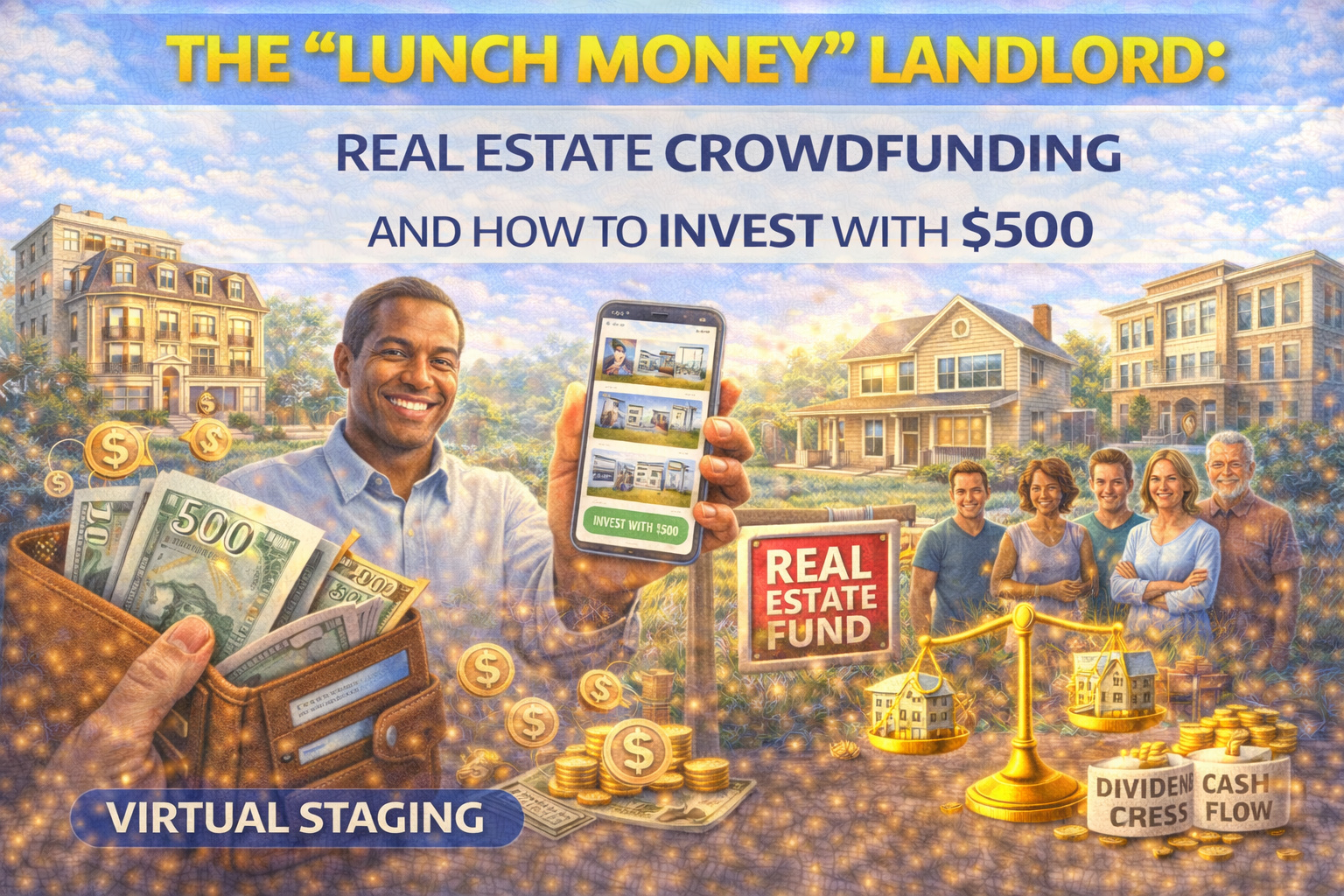
Stuck renting because you lack a down payment? Real estate crowdfunding lets you own a slice of the pie for as little as $500. See how it works and where to start.
Table of Contents
I used to think being a “real estate investor” required three things: a rich uncle, a suit, and a briefcase full of cash. For years, I sat on the sidelines, watching property prices climb while I frantically tried to save up that mythical 20% down payment. By the time I saved $10,000, the market had moved, and I needed $15,000. It felt like running on a treadmill.
Then, the game changed. The passing of the JOBS Act a few years back cracked the door open for regular people—folks like you and me who don’t have $50,000 sitting in a savings account—to get into the game.
It’s called real estate crowdfunding. It’s the concept that turned the industry on its head, allowing you to own a piece of a high-rise in Manhattan or an apartment complex in Texas for the cost of a PlayStation. If you are tired of saving for a down payment that feels out of reach, this might be the side door you’ve been looking for.
What is Real Estate Crowdfunding?
Imagine a developer wants to build a $20 million apartment complex. In the old days, they would go to a bank for $15 million and then find one or two wealthy tycoons to put up the remaining $5 million. If you didn’t have a million bucks, you weren’t invited to the meeting.
Real estate crowdfunding disrupts that exclusive club. Instead of finding one guy with $5 million, the developer goes online and finds 5,000 people willing to invest $1,000 each.
You pool your money with thousands of other investors. The developer builds the building, rents it out, and you get a share of the rental income (dividends) and a share of the profit when they sell it (appreciation). It’s essentially “Kickstarter” for buildings, but instead of getting a T-shirt, you get equity.
The Two Main Flavors: Debt vs. Equity
When you dive into real estate crowdfunding, you aren’t just “buying a building.” You are usually buying into a specific financial structure. Understanding the difference is crucial for your risk tolerance.
1. Equity Crowdfunding
This is the high-risk, high-reward play. You are technically a partial owner of the property.
- The Upside: You get quarterly cash flow from rents and a payout if the property value goes up.
- The Downside: You are last in line to get paid. If the project fails or the market crashes, the bank gets paid first, and you might lose your principal.
2. Debt Crowdfunding
Here, you are acting as the bank. You are lending money to the developer to renovate or build a house.
- The Upside: The returns are fixed (e.g., 8% or 10% annually). You get paid before the equity owners.
- The Downside: Your upside is capped. If the building sells for double the price, you don’t get a bonus; you just get your interest.
Do You Need to Be Rich? (Accredited vs. Non-Accredited)
For a long time, the best real estate crowdfunding deals were reserved for “accredited investors”—people earning over $200,000 a year or with a net worth over $1 million. It was the government’s way of saying, “You can only take this risk if you can afford to lose money.”
However, platforms like Fundrise and RealtyMogul have popularized “eREITs” (Electronic Real Estate Investment Trusts). These allow non-accredited investors (regular folks) to invest with minimums as low as $10 or $500.
This democratization is why real estate crowdfunding has exploded. You no longer need to be part of the country club set to own commercial assets.
The Massive Benefits of Going Small
Why would you choose real estate crowdfunding over just buying a rental property down the street?
1. True Passive Income
I own rental properties. Let me tell you, when a toilet explodes at 2 AM, it is not passive income. It is a part-time job. With crowdfunding, you are completely hands-off. You don’t deal with tenants, termites, or toilets. You just check your dashboard to see if a dividend hit your account.
2. Instant Diversification
If you have $50,000 and you buy one house, your entire fortune is tied to that one neighborhood. If a major employer leaves town, your investment tanks. With $50,000 in real estate crowdfunding, you could split that across 50 different projects in 10 different states. You could own a slice of an industrial warehouse in Ohio, a medical office in Florida, and a luxury condo in LA.
3. Access to “Institutional” Grade Assets
Most of us can’t afford to buy a 300-unit apartment complex. Those assets are usually more stable and profitable than single-family homes. Real estate crowdfunding is the only way for a small investor to get a foot in the door of these massive commercial deals.
The Risks: It’s Not All Sunshine and Dividends
I’d be lying if I said this was a guaranteed win. There are distinct risks with real estate crowdfunding that don’t exist in the stock market or traditional home ownership.
The Liquidity Trap
This is the big one. If you buy a stock on Monday, you can sell it on Tuesday. Real estate crowdfunding is an illiquid asset. When you give them your money, it is often locked up for 3, 5, or even 7 years.
Some platforms offer “early redemption” programs where you can ask for your money back early, but they usually charge a penalty, and they can suspend these programs during a crisis (like we saw in 2020). Do not invest your emergency fund here.
Platform Risk
What happens if the website shuts down? While the underlying real estate usually sits in a separate legal entity (like an LLC) to protect it from the platform’s bankruptcy, it would still be a messy legal headache to sort out. Stick to established players with a track record.
The Fees
Read the fine print. Most real estate crowdfunding platforms charge an annual asset management fee (usually 1% to 2%). On top of that, the developer might have their own fees buried in the deal. These fees can eat into your returns if the property doesn’t perform well.
Link to NerdWallet’s Review of Best Crowdfunding Platforms
How to Choose a Platform
There are dozens of sites popping up, but they generally fall into two buckets:
- For Beginners ($10 – $1,000): Look at Fundrise or Groundfloor. These are designed for the everyday investor. They do the heavy lifting of vetting deals and bundling them into portfolios for you.
- For Big Players ($10,000+): Look at CrowdStreet or EquityMultiple. These usually require you to be an accredited investor, but they let you pick and choose specific, high-yield commercial projects.
A Real-World Example: My First $1,000
A few years ago, I decided to test the waters. I put $1,000 into a diversified eREIT on a popular real estate crowdfunding platform. I didn’t get rich overnight.
The first quarter, I earned about $15 in dividends. It wasn’t life-changing money. But then I looked at my bank savings account, which had earned about $0.40 in the same period. Over time, that investment compounded. The property values in the portfolio increased. I wasn’t doing any work, yet my money was working harder than it ever did in the bank.
Crowdfunding vs. REITs: What’s the Difference?
You might be asking, “Can’t I just buy a REIT stock on the New York Stock Exchange?”
Yes, you can. Publicly traded REITs are great because they are liquid (easy to sell). However, they are also volatile. They tend to move in sync with the stock market. If the S&P 500 crashes, public REITs often crash too, even if the real estate market is fine.
Real estate crowdfunding investments are private. They don’t have a ticker symbol blinking red every day. Their value is based on the actual appraisal of the property, not market sentiment. This makes them a great stabilizer for your portfolio when the stock market is going crazy.
Taxes: The Uncle Sam Factor
Warning: real estate crowdfunding makes your taxes complicated.
Unlike stocks where you get a simple 1099-DIV form, many crowdfunding deals are structured as partnerships. This means you might receive a Schedule K-1 form. These are notoriously annoying to file and often arrive late in the tax season.
However, the benefit is that you often get to take advantage of depreciation. This is a “phantom expense” that lowers your taxable income on paper, even if you made money in real life. It’s one of the best tax loopholes in the real estate world, and you get to use it even with a $500 investment.
Conclusion
The era of gatekeepers is over. You no longer need to know a guy who knows a guy to invest in commercial real estate. Real estate crowdfunding has leveled the playing field, allowing anyone with a few hundred bucks to start building a portfolio of tangible assets.
Is it a get-rich-quick scheme? Absolutely not. It requires patience and a willingness to lock up your money for the long haul. But if you want to diversify away from the stock market and start earning passive income from bricks and mortar, there has never been a better time to start.
Don’t let the $50,000 down payment barrier stop you. Start with $500. Start today. Your future self (and your wallet) will thank you.
FAQ Section
1. Can I lose money with real estate crowdfunding? Yes. Just like any investment, there is risk. If the property market crashes, vacancies rise, or the developer mismanages the project, you could lose some or all of your principal. Unlike a savings account, real estate crowdfunding is not FDIC insured.
2. How long is my money tied up? It varies by platform and project, but you should expect a timeline of 3 to 7 years. While some platforms offer quarterly liquidity, it is never guaranteed. Treat this as a long-term investment.
3. What is the average return? Historically, returns for real estate crowdfunding have ranged from 7% to 12% annually, depending on the risk profile of the projects (debt deals usually offer lower, safer returns; equity deals offer higher, riskier returns).
4. Do I have to be a US citizen to invest? Most major US platforms require you to be a US resident with a valid tax ID (Social Security Number). However, there are international platforms emerging in Europe and Asia that cater to global investors.
5. How are the dividends paid? Most platforms pay dividends quarterly. You can usually choose to have them deposited directly into your bank account (passive income!) or automatically reinvested to harness the power of compound interest.
6. Is real estate crowdfunding better than owning a rental? It depends on your goals. Owning a rental offers more control and potential tax benefits, but it requires work. Real estate crowdfunding offers less control but requires zero effort. It is “better” if you value your time over maximum leverage.