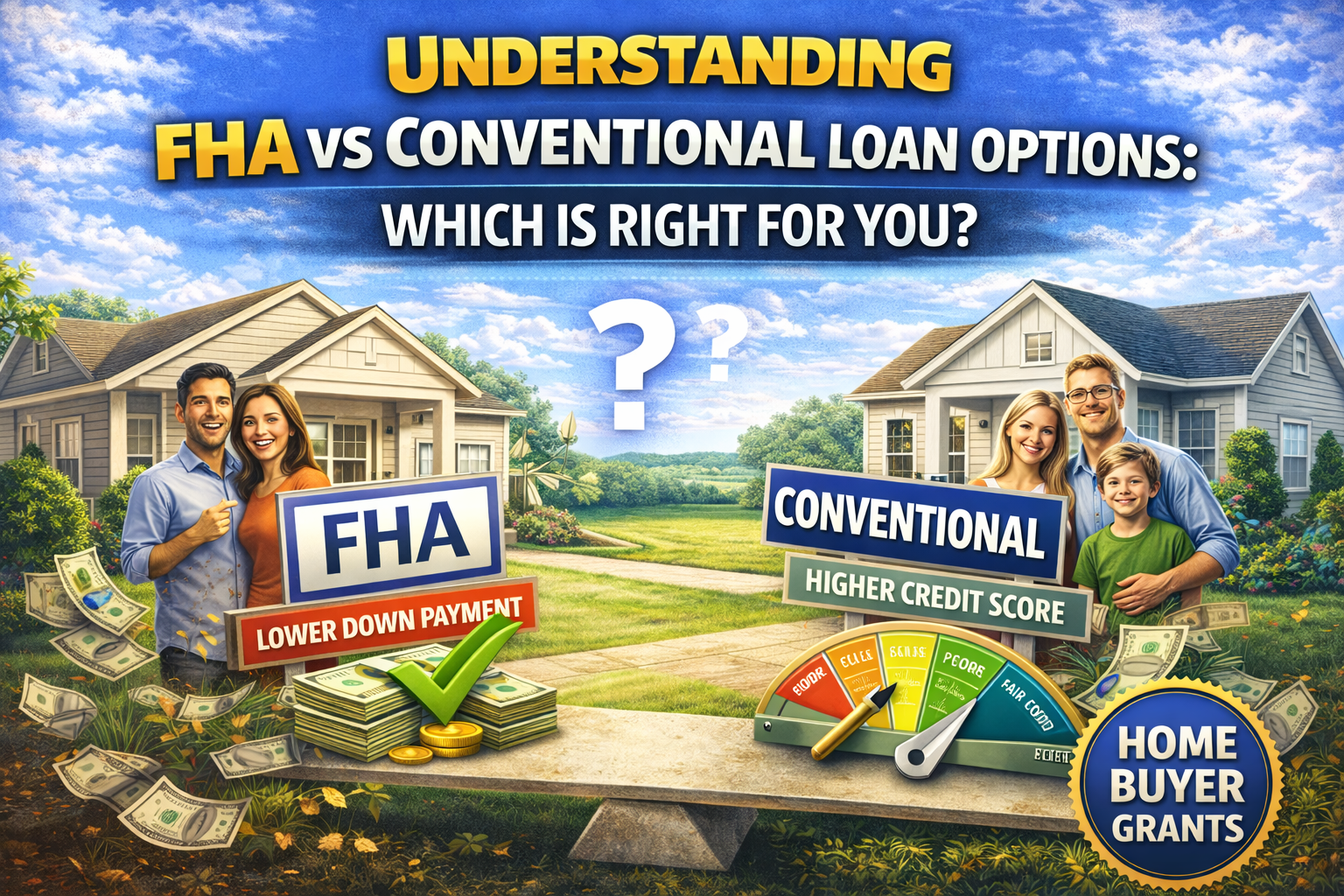
Stuck choosing between an FHA vs conventional loan? We break down the credit scores, down payments, and hidden insurance costs to help you pick the winner.
Table of Contents
I sat across from a first-time buyer named Marcus a few weeks ago. He had his Zillow app open in one hand and a crumpled pre-approval letter in the other. He looked at me, totally bewildered, and asked, “My lender said I qualify for both, but the monthly payments look different. Why does it matter if the government backs it or not?”
It was the classic FHA vs conventional loan confusion.
To the average person, a mortgage is just a mortgage. You borrow money, buy a house, and pay it back for 30 years. But under the hood, these two loan types are completely different engines. Choosing the wrong one can cost you thousands of dollars in wasted insurance premiums or, worse, get your offer rejected by a seller.
If you are standing at the crossroads of financing, you need to look past the interest rate. You need to understand the rules of engagement. Let’s strip away the banker jargon and look at the real-world differences in the FHA vs conventional loan battle so you can sign those closing papers with confidence.
The 30-Second Overview: What Are They?
Before we get into the nitty-gritty, let’s define the contenders.
The FHA Loan: This is the government’s safety net for homebuyers. Backed by the Federal Housing Administration, it is designed to help people with lower credit scores or smaller savings accounts get into a home. The government insures the bank against loss, so the bank can be a little more risky with you.
The Conventional Loan: This is the private market standard. These loans are not insured by the government (though they are often bought by Fannie Mae or Freddie Mac). Because the government isn’t holding the bank’s hand, the bank sets stricter rules.
When weighing an FHA vs conventional loan, think of it this way: FHA is the “forgiving friend,” while Conventional is the “strict parent.”
Round 1: The Credit Score Barrier
This is usually where the decision is made for you. If your credit history has a few bumps in the road, the FHA vs conventional loan debate ends quickly.
FHA Loans are incredibly lenient. You can technically qualify with a credit score as low as 580 and still only put 3.5% down. If you have a score between 500 and 579, you can still qualify, but you usually need 10% down. I’ve helped clients who are just two years out of bankruptcy get an FHA loan.
Conventional Loans are much pickier. Generally, you need a credit score of at least 620 just to get a seat at the table. And here is the kicker: just because you qualify with a 620 doesn’t mean you get a good deal. Conventional lenders use “risk-based pricing.” If your score is 640, your interest rate and insurance costs will be significantly higher than if your score was 760.
In the FHA vs conventional loan comparison, FHA is the clear winner for anyone with a credit score below 660. The rate is often the same whether your score is 600 or 800.
Round 2: The Down Payment Myth
I hear this every week: “I need an FHA loan because I don’t have 20% down.”
Let’s kill this myth right now. You do not need 20% down for a conventional loan.
- FHA: Requires 3.5% down.
- Conventional: Requires as little as 3% down for first-time homebuyers (and 5% for everyone else).
Surprised? In many cases, a conventional loan actually requires less cash upfront than an FHA loan. However, the source of that money matters. FHA is very generous about letting you use gift funds from family for the entire down payment. Conventional loans allow gifts too, but they scrutinize the paper trail a bit more heavily.
When analyzing FHA vs conventional loan options strictly on upfront cash, it’s basically a tie.
Round 3: The Mortgage Insurance Trap (MIP vs. PMI)
This is the most critical financial difference. If you skim everything else, read this section.
Both loans require you to pay extra insurance if you put less than 20% down. This protects the lender if you stop paying. But they treat this insurance very differently.
FHA Mortgage Insurance Premium (MIP): With an FHA loan, you get hit twice.
- Upfront MIP: You pay 1.75% of the loan amount at closing (usually rolled into the loan). On a $300,000 house, that’s $5,250 added to your debt immediately.
- Monthly MIP: You pay an annual premium (usually 0.55% to 0.75%) divided into monthly payments.
- The Kicker: If you put less than 10% down, FHA mortgage insurance never goes away. It stays for the life of the loan. The only way to get rid of it is to refinance into a conventional loan later.
Conventional Private Mortgage Insurance (PMI): There is no upfront fee. You just pay a monthly premium. The cost depends heavily on your credit score. If you have amazing credit, PMI is dirt cheap. If you have bad credit, it’s expensive.
- The Benefit: PMI falls off automatically. Once you pay your loan down to 78% of the original value (build 22% equity), the insurance vanishes. No refinance needed.
When you look at the long-term cost of an FHA vs conventional loan, the Conventional loan usually wins for buyers with good credit because the insurance is temporary and there is no upfront fee.
Round 4: Debt-to-Income (DTI) Ratios
How much debt can you carry and still buy a house?
Lenders look at your Debt-to-Income Ratio—the percentage of your gross monthly income that goes toward debts like student loans, car payments, and the new mortgage.
Conventional loans typically cap this at 45% (sometimes 50% with strong reserves). FHA loans are the heavy lifters here. I’ve seen FHA loans get approved with DTI ratios as high as 57%. If you have significant student loan debt or a high car payment, the FHA vs conventional loan choice often swings toward FHA simply because it gives you more buying power.
Round 5: The Property Inspection (The “Peeling Paint” Rule)
This is where the seller gets involved.
If you are buying a fixer-upper, be careful. FHA appraisers are required to look for health and safety issues. The most famous one is peeling paint on homes built before 1978 (lead paint risk). If an FHA appraiser sees peeling paint, a loose handrail, or a missing GFI outlet, they will flag it. The loan will not close until those items are fixed.
Conventional appraisers are more focused on value. They might note a broken window, but unless the house is falling down, they typically won’t kill the deal over minor condition issues.
In a competitive market, sellers often prefer Conventional offers over FHA offers because they don’t want to deal with the stricter appraisal repairs. When evaluating FHA vs conventional loan offers, a seller might pick the Conventional buyer just to avoid the hassle.
Link to HUD’s FHA Loan Requirements
The “House Hacking” Angle
If you are an investor looking to buy a multi-family property (2-4 units) and live in one unit, the FHA vs conventional loan math gets interesting.
FHA allows you to buy a 4-unit building with just 3.5% down. This is the ultimate “house hack.” Until recently, Conventional loans required 15-25% down for multi-unit properties. However, new rules from Fannie Mae now allow 5% down on owner-occupied 2-4 unit properties. This has leveled the playing field significantly, making the FHA vs conventional loan decision for investors much tighter.
Real-Life Example: The Cost Breakdown
Let’s run the numbers on a $400,000 home with a 3.5% down payment ($14,000).
Scenario A: FHA Loan (Credit Score 640)
- Interest Rate: Generally lower (let’s say 6.0%).
- Upfront MIP: $6,755 added to loan balance.
- Monthly MIP: ~$175/month (Permanent).
- Total Payment: Lower initially, but higher over 30 years due to permanent insurance.
Scenario B: Conventional Loan (Credit Score 640)
- Interest Rate: Higher (let’s say 6.75% because of the score).
- Monthly PMI: Expensive (~$300/month because of the score).
- Result: The monthly payment is significantly higher.
Scenario C: Conventional Loan (Credit Score 760)
- Interest Rate: Competitive (6.125%).
- Monthly PMI: Cheap (~$80/month).
- Result: This is the clear winner.
This illustrates why your credit score is the compass for the FHA vs conventional loan map.
Which One Should You Pick?
Here is my cheat sheet for deciding between an FHA vs conventional loan:
Choose FHA If:
- Your credit score is below 680.
- You have a high Debt-to-Income ratio (lots of monthly debts).
- You plan to refinance or move in 5-7 years (making the permanent MIP less painful).
- You are receiving a large gift for the down payment and reserves.
Choose Conventional If:
- Your credit score is 700 or higher.
- You have significant savings (reserves).
- You are buying a “fixer-upper” that might fail an FHA inspection.
- You plan to stay in the home forever and want the mortgage insurance to eventually disappear.
- You want to make your offer more attractive to sellers.
Link to Fannie Mae’s Conventional Loan Basics
Conclusion
There is no “bad” loan, only the wrong loan for your specific situation. The FHA vs conventional loan debate isn’t about which one is objectively better; it’s about which one fits your financial profile today.
If you have excellent credit, the Conventional loan is usually the smarter, cheaper long-term play. But if you need a little flexibility, the FHA loan is an incredible tool that has helped millions of families stop renting and start owning.
Don’t let the acronyms scare you. Look at your credit score, look at your savings, and pick the tool that gets you the keys.
Still unsure which loan fits your budget? I can introduce you to a lender who can run a “side-by-side” comparison for your specific income—just drop a comment below!
FAQ Section
1. Is it harder to get an FHA vs conventional loan? Generally, FHA loans are easier to qualify for because they allow lower credit scores and higher debt ratios. Conventional loans have stricter underwriting guidelines regarding your financial history.
2. Can I switch from an FHA to a conventional loan later? Yes! This is a very common strategy. Buyers often start with an FHA loan to get into the house, work on improving their credit score, and then refinance into a conventional loan a few years later to eliminate the monthly mortgage insurance.
3. Do sellers hate FHA loans? “Hate” is a strong word, but in a multiple-offer situation, sellers often view FHA loans as riskier. They worry about the appraisal coming in low or the inspector flagging minor repairs. A strong Conventional offer often beats an FHA offer if the price is identical.
4. Are interest rates lower on FHA vs conventional loans? Typically, yes. FHA interest rates are often slightly lower than conventional rates because the government guarantee makes the loan safer for the investor. However, the higher APR (due to the mortgage insurance) can make the overall cost higher.
5. Can I use an FHA loan for an investment property? No. FHA loans are strictly for primary residences. You must live in the property. However, you can use a Conventional loan for a second home or rental property, though the down payment requirement will be higher (usually 15-25%).
6. What is the loan limit for FHA vs conventional loans? Both loans have maximum limits that vary by county. In 2024-2025, conventional loan limits are generally higher than FHA limits in many areas. If you are buying a luxury home, you might be forced into a “Jumbo” conventional loan because FHA won’t cover that amount.