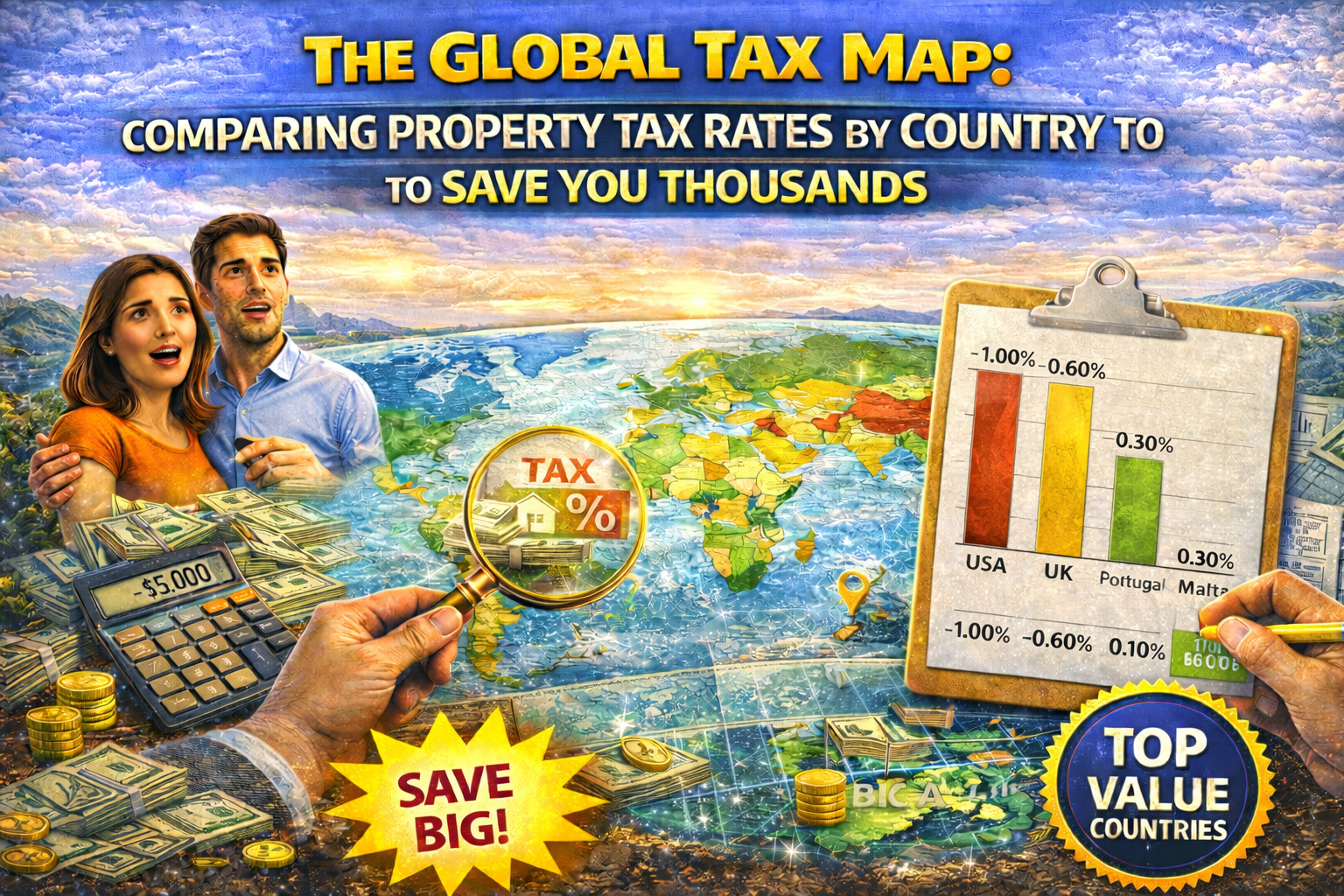
Tired of losing rental income to the taxman? We dive deep into property tax rates by country, revealing where you can buy real estate to minimize expenses and maximize your yield.
Table of Contents
I’ll never forget the phone call I got from a client named Sarah last year. She had just inherited a beautiful, historic farmhouse in rural France. She was ecstatic—until the tax bill arrived. Between the taxe foncière and the taxe d’habitation, her dream inheritance was suddenly costing her thousands of euros a year just to sit empty.
“I thought once I owned it, it was free!” she lamented.
It is the single biggest misconception in real estate. We obsess over the purchase price, the interest rate, and the potential renovation costs, but we often ignore the silent wealth-killer: the annual holding costs. Whether you are a digital nomad looking for a home base or an investor chasing yield, understanding property tax rates by country is critical.
The difference between a savvy investment and a money pit often comes down to jurisdiction. In New Jersey, you might pay 2.5% of the home’s value every single year to the local government. In Dubai? You pay 0%. That massive discrepancy changes your entire return on investment (ROI). If you are looking to keep more of your hard-earned money, let’s take a trip around the world and look at the real costs of ownership.
The Three Layers of Property Taxation
Before we start ranking nations, you have to understand that “property tax” isn’t just one bill. When analyzing property tax rates by country, you need to look at the “Triple Threat”:
- Transfer Tax (Stamp Duty): The cost to buy.
- Recurrent Property Tax: The cost to hold (this is the big one).
- Capital Gains Tax: The cost to sell.
Some countries trap you with cheap annual taxes but hammer you when you buy. Others let you buy for cheap but bleed you dry every year. The smartest real estate investor looks at the total lifecycle cost, not just one line item.
The High-Cost Offenders: Where Taxes Eat Profits
If you are purely looking to minimize expenses, you might want to tread carefully in North America and Western Europe. When you start comparing property tax rates by country, the United States consistently ranks near the top for annual holding costs.
While the U.S. doesn’t have a federal property tax, local municipalities rely on it to fund schools. In states like Illinois, New Jersey, and Texas, effective rates can exceed 2%. That means on a $500,000 house, you are paying $10,000+ a year forever. That eats a massive hole in your net rental yield.
Europe isn’t much better. In France, as my client Sarah found out, holding costs can be steep. The UK has “Council Tax,” which is based on the value of the property… in 1991. It’s a confusing system, but it’s an unavoidable expense. When reviewing property tax rates by country, these nations are high-maintenance zones for your wallet.
The “Tax-Free” Miracles: The Gulf and the Islands
Now, let’s look at the winners. If your goal is zero annual holding costs, you need to look at the Middle East and the Caribbean.
The United Arab Emirates (specifically Dubai) is the gold standard right now. There is zero annual property tax. Once you pay the initial transfer fee (4% to the Dubai Land Department), you own it. You don’t get a bill in the mail every year just for existing. When looking at property tax rates by country, Dubai is almost impossible to beat for pure cash flow preservation.
Similarly, the Cayman Islands and Turks & Caicos offer a similar structure. They rely on high import duties and consumption taxes rather than taxing property owners. This makes them incredibly attractive for retirees who live on a fixed income and can’t afford a fluctuating tax bill.
The “Low-Cost” Middle Ground: Southeast Asia
If you can’t afford a villa in the Caribbean, look East. Southeast Asia offers some of the most favorable terms when analyzing property tax rates by country.
Thailand, for example, recently revamped its tax code, but it remains incredibly low compared to the West. The Land and Building Tax is often less than 0.3% for residential homes. In the Philippines, the “Real Property Tax” rarely exceeds 2% of the assessed value, which is usually much lower than the actual market value.
For an investor, these low rates mean your rental income stays in your pocket rather than going to the local municipality. It acts as a natural buffer against inflation.
The “Transfer Tax” Trap
Here is where it gets tricky. Some countries look cheap on an annual basis but punish you upfront.
Take Belgium, for example. The annual tax is manageable, but the registration tax (transaction cost) when you buy can be as high as 12.5%. You have to hold that property for years just to break even on the entry fees.
When you are researching property tax rates by country, you must add the “Stamp Duty” to your spreadsheet. In Singapore, foreigners get hit with a massive Additional Buyer’s Stamp Duty (ABSD) of 60%. So, even though the annual tax is low, the cost of entry is astronomical. It completely skews the property tax rates by country comparison for non-residents.
Link to Global Property Guide Tax Ratings
Wealth Taxes: The Hidden Layer
In some jurisdictions, real estate counts toward your total net worth for a “Wealth Tax.” This is distinct from a standard property tax.
Spain is infamous for this. If you are a tax resident (or even a non-resident in some regions) and you own significant assets, you pay a percentage of your total global wealth every year. Real estate is not exempt. When evaluating property tax rates by country, you have to ensure you aren’t accidentally triggering a wealth tax liability that wipes out your profits.
How Residency Affects the Rate
Your passport or visa status matters. Many governments are turning protectionist, charging higher property tax rates by country for foreigners than for locals.
- Canada: Implemented an “Underused Housing Tax” targeting foreign owners of vacant properties.
- Australia: Foreign buyers often pay higher stamp duties and land taxes.
If you are buying abroad, you need to ask: “Does this rate apply to me, or just to citizens?” The advertised rate on a listing site is often the local rate, not the “gringo rate.”
Strategies to Minimize Your Exposure
So, how do you fight back? You can’t evade taxes (that’s illegal), but you can avoid them (that’s smart).
- Buy in “Fee Simple” jurisdictions: Avoid leasehold properties where ground rent adds another layer of cost.
- Look for “Tax Abatements”: Even in high-tax countries like the US, certain zones offer 10-year tax holidays for new construction.
- Use Corporate Structures: In some places, holding property in an LLC or a local corporation can change how the tax is calculated, shifting it from personal income to corporate tax rates.
Analyzing property tax rates by country allows you to cherry-pick these advantages. Why fight a 2% tax in New Jersey when you can pay 0.1% in Panama?
Link to OECD Property Tax Revenue Statistics
Conclusion
Real estate is a global asset class, and you should shop for it like one. Don’t limit yourself to your backyard where the tax assessor treats your home like an ATM.
By carefully comparing property tax rates by country, you can find jurisdictions that actually respect property rights and encourage investment. Whether it’s the zero-tax allure of Dubai or the low-holding-cost stability of Thailand, the world is full of opportunities to keep your expenses low.
Remember, it’s not just about how much rent you collect; it’s about how much you keep. Do the math on the annual taxes before you fall in love with the view.
Are you debating between two different countries for your next purchase? I have a spreadsheet that compares the 10-year holding costs for the top 5 expat destinations—drop a comment below and I’ll share the data!
FAQ Section
1. Which country has the highest property taxes? The United States is consistently near the top when looking at recurrent annual taxes as a percentage of property value, specifically in states like New Jersey and Illinois. However, when looking at transaction taxes (purchase costs), countries like Belgium and Singapore (for foreigners) are incredibly expensive. When comparing property tax rates by country, you have to define if you mean “buying” or “holding.”
2. Are there countries with absolutely no property tax? Yes. Countries like the United Arab Emirates (Dubai), Kuwait, Saudi Arabia, and several Caribbean nations (like the Cayman Islands) do not levy an annual property tax. You typically only pay a one-time transfer fee when you buy. This makes them standout winners in any property tax rates by country analysis.
3. Do foreigners pay the same property taxes as locals? Not always. In an effort to cool housing markets, countries like Singapore, Canada, and Australia have introduced additional surcharges or higher tax brackets for foreign buyers. Always verify the property tax rates by country specifically for non-residents.
4. How does property tax impact rental yield? It is a direct deduction from your gross income. If a property generates an 8% gross yield but the property tax is 2%, your net yield is heavily reduced. In a zero-tax jurisdiction, that same 8% gross yield might result in a 7.5% net yield (after maintenance), making it a far superior investment.
5. Can I deduct foreign property taxes on my US tax return? Generally, no. Since the Tax Cuts and Jobs Act of 2017, you can no longer deduct foreign property taxes on your personal Schedule A. However, if the property is a rental business, you can usually deduct the taxes as a business expense against the rental income. This is a crucial detail when calculating property tax rates by country for US citizens.
6. What is the difference between Stamp Duty and Property Tax? Stamp Duty (or Transfer Tax) is a one-time fee paid at the closing table when you buy the property. Property Tax is a recurring bill (usually annual) that you pay for as long as you own the home. Both are essential factors when researching property tax rates by country.