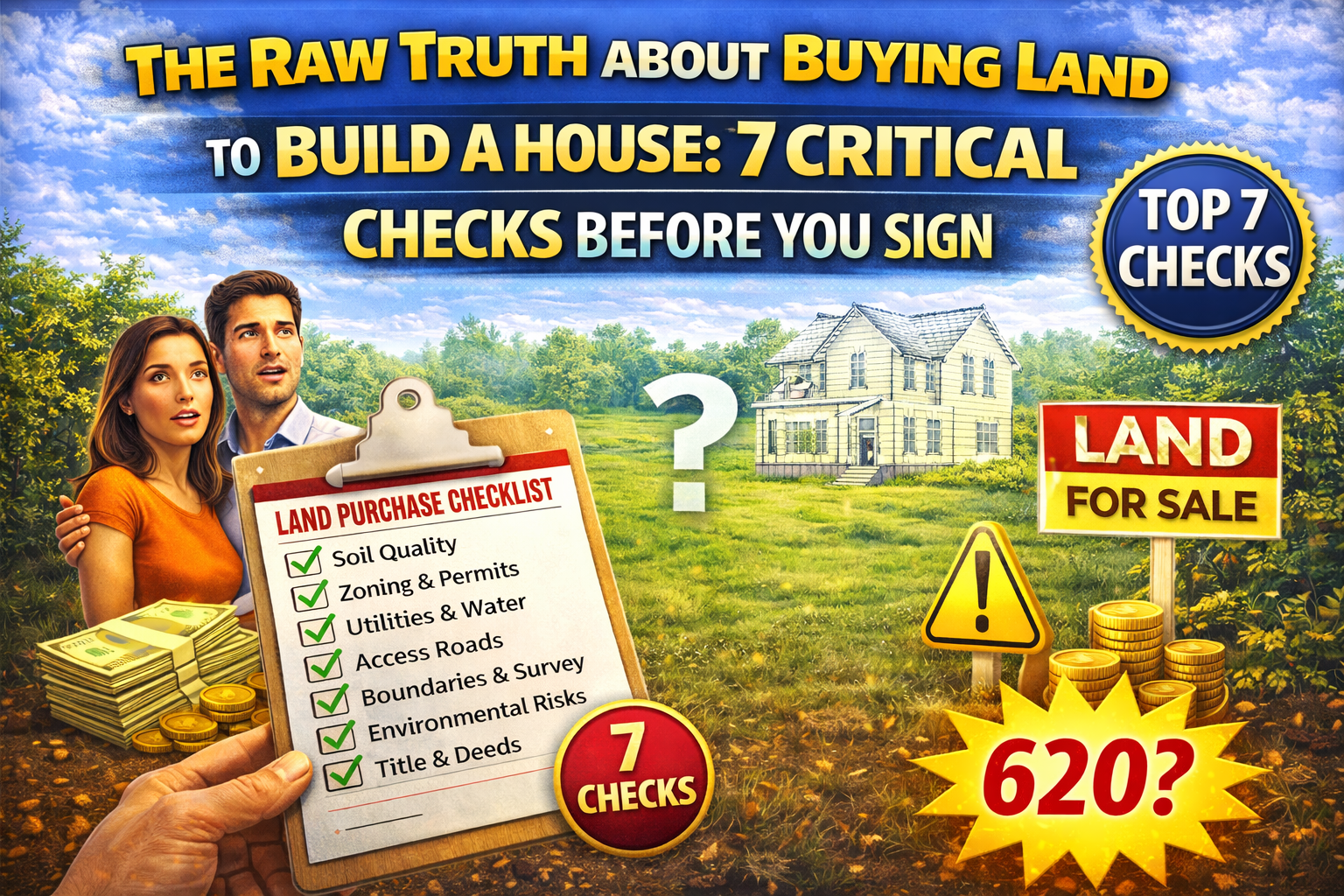
Dreaming of building from scratch? Don’t get stuck with a “dirt” lemon. Learn the 7 vital things you must check when buying land to build a house in 2026.
Table of Contents
I recently stood on a beautiful five-acre lot with a client who was ready to pull the trigger. The views were breathtaking—rolling hills, a distant river, and the kind of quiet you only find far away from the suburbs. He had already mentally placed his living room window right where the sunset hits. “It’s perfect,” he said.
I had to be the buzzkill. I pointed toward a small, innocent-looking patch of cattails near the center of the lot. “That’s a wetland,” I told him. “And those power lines at the edge? They might have an easement that prevents you from building within 50 feet.”
By the time we ran the numbers for a septic system and a 500-foot driveway, his “bargain” lot was suddenly more expensive than a move-in-ready home in the city.
Buying land to build a house is the ultimate American dream, but it can quickly turn into a financial nightmare if you don’t know what lies beneath the surface. When you buy an existing home, you can see the flaws. When you buy land, the flaws are invisible. If you’re serious about building your own sanctuary, you need to treat the dirt like a high-stakes investigation.
Here are the 7 things you absolutely must check when you are buying land to build a house to ensure your dream home doesn’t get stuck in the mud.
1. Zoning Laws and Land Use Restrictions
The very first thing you need to realize about buying land to build a house is that just because you own the land doesn’t mean you can do whatever you want with it.
Every municipality has zoning laws that dictate the type of structure allowed. You might want to build a tiny home, but the local code requires a minimum of 1,500 square feet. Or perhaps you want to keep chickens, but the land is zoned strictly residential.
Always check the “setback” requirements. These are the mandatory distances between your house and the property lines. If you have a narrow lot and 25-foot side setbacks, your “huge” house might have to be a skinny skyscraper.
2. The Great Utility Quest: Power, Water, and Sewer
This is where the hidden costs of buying land to build a house really start to stack up. If the land is “unimproved,” you are responsible for bringing civilization to the lot.
- Sewer vs. Septic: If there is no municipal sewer line, you’ll need a septic system. Before you buy, you must perform a “Perc Test” (percolation test). If the soil doesn’t drain properly, you might be forced to install an “engineered system,” which can cost $30,000 instead of $8,000.
- Water: Is there a city water hookup? If not, you’re digging a well. I’ve seen homeowners dig 400 feet and find nothing but dry rock.
- Power: If the nearest power pole is half a mile away, the utility company will charge you by the foot to bring lines to your door. It gets expensive fast.
3. Easements and Right-of-Ways
An easement is basically a legal “hall pass” that allows someone else to use part of your land. This is a crucial check when buying land to build a house.
Utility companies often have easements to run lines across your property. Your neighbor might have a “right-of-way” easement to use your driveway to get to their landlocked property. You generally cannot build permanent structures on an easement. If your dream pool happens to be right over a buried fiber-optic line, the county will shut you down before you even break ground.
4. Soil Quality and Topography
Not all dirt is created equal. When you are buying land to build a house, the topography—the “lay of the land”—determines your construction costs.
A lot with a steep slope might look cool for a walk-out basement, but the cost of retaining walls and specialized foundations can be staggering. You also need to watch for “expansive soils” like clay, which can shift and crack your foundation over time. I always recommend a geotechnical report for any piece of land that isn’t perfectly flat and sandy. It’s a few thousand dollars now that could save you a hundred thousand in foundation repairs later.
5. Environmental Hazards and Protected Zones
In 2026, environmental regulations are tighter than ever. If you are buying land to build a house, you need to check for wetlands, floodplains, and protected habitats.
Building in a flood zone means higher insurance premiums and strict building codes (like elevating the first floor). If you find a rare species of owl or a protected plant on your lot, the state might bar you from clearing trees. Don’t take the seller’s word for it; check the official county environmental maps yourself.
6. Access and Road Maintenance
How do you get to your front door? It sounds like a simple question, but when buying land to build a house, access is a major legal hurdle.
If the land is on a private road, who pays to plow the snow? Who pays to fill the potholes? You’ll want to see a Road Maintenance Agreement signed by all the neighbors. If the lot is “landlocked” (surrounded by other people’s property with no street access), you cannot build until you legally secure an access easement. Without it, you’ve just bought a very expensive park that you can’t get to.
7. The True Cost of “Impact Fees”
Many first-time land buyers are shocked by impact fees. These are one-time charges by the local government to help pay for the increased “impact” your new home will have on schools, parks, and roads.
Depending on your county, when buying land to build a house, you might have to write a check for $10,000 to $20,000 to the school district or the fire department just to get your building permit. This isn’t part of your construction loan; it’s an upfront cost of doing business with the city.
FAQ Section
1. Can I get a regular mortgage when buying land to build a house? No. Traditional mortgages are for existing homes. When buying land to build a house, you typically need a land loan or a construction loan. Land loans usually require higher down payments (20% to 50%) and have higher interest rates because they are considered riskier by banks.
2. How do I know where the property lines actually are? Never trust a fence line or a “feeling.” You must hire a licensed surveyor to perform a boundary survey. They will find the iron pins in the ground and give you a legal map of exactly what you own. This is non-negotiable when buying land to build a house.
3. What is a “Perc Test” and why do I need one? A Perc Test measures how quickly water is absorbed into the soil. If you’re building in a rural area without city sewer, the health department requires this test to ensure your septic system won’t fail and contaminate the local groundwater.
4. Should I buy land now and build later? This can be a smart move to “lock in” a location, but remember that you’ll be paying property taxes and potentially HOA dues on a piece of dirt that isn’t making you any money. Also, zoning laws can change, so what is buildable today might not be in five years.
5. How much does it cost to clear land? Clearing trees, removing stumps, and grading the site for a foundation can cost anywhere from $5,000 to $20,000 per acre depending on the density of the brush. Make sure to factor “site prep” into your budget when buying land to build a house.
6. Can I build my own house to save money? Only if you are a licensed contractor in many jurisdictions. Even then, most banks won’t give you a construction loan if you are the “Owner-Builder” unless you have a proven track record. For most people, hiring a custom home builder is the safest route.
Conclusion
Building a home is a marathon, not a sprint. The foundation of that marathon is the dirt you choose. While the process of buying land to build a house is filled with more “red tape” than buying a condo, the reward is a home that is uniquely yours, built exactly to your specifications.
Take your time. Do the soil tests. Talk to the county planners. Check the easements. If you do the boring legwork now, you can spend the rest of your life enjoying that sunset from the exact window you imagined.