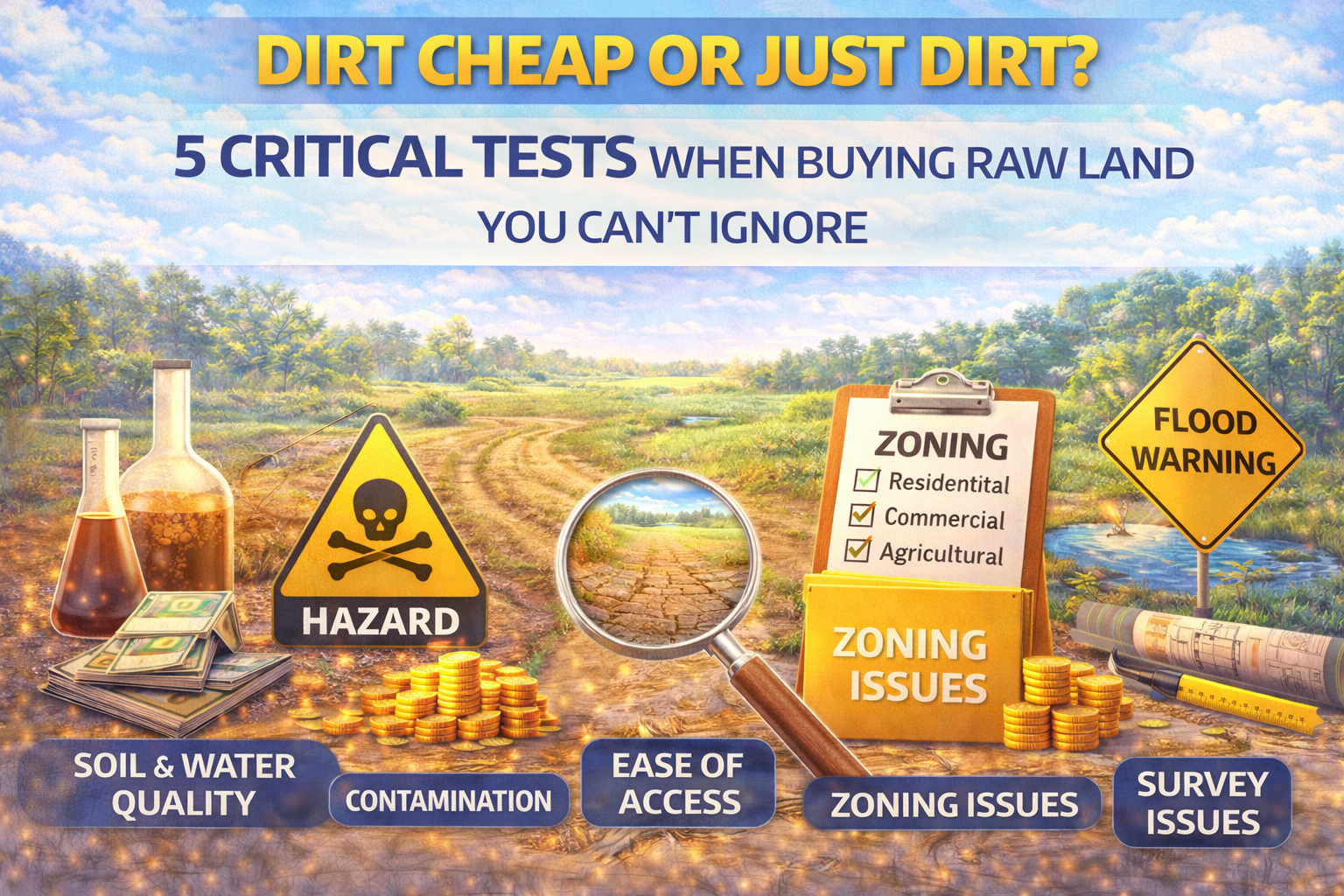
Thinking about buying raw land? Don’t get stuck with a lot you can’t build on. Learn the 5 essential tests for soil, zoning, and utilities before you buy.
Table of Contents
There is something incredibly intoxicating about standing on a vacant lot, looking at a sunset, and imagining your future home sitting right there. I’ve been there. I remember walking a five-acre parcel in the Pacific Northwest and thinking, “This is it. This is the dream.” The price was low, the trees were tall, and I was ready to sign the papers that afternoon.
Then my mentor pulled me aside and asked a very annoying, very important question: “Where is the water coming from?” It sounds simple, but that one question opened a rabbit hole of bureaucracy and expense I wasn’t prepared for. Buying raw land is the ultimate romantic real estate move, but it is also the most technically dangerous.
Unlike buying an existing house where the “bones” are already there, when you are buying raw land, you are buying a blank slate that might be hiding a million-dollar problem under the surface. If you don’t do your homework, that “bargain” lot can quickly become an expensive nature preserve that you are legally forbidden from building on. Let’s talk about the five tests that will save your bank account and your sanity.
1. The Perc Test: Can Your Land Breathe?
If you are buying raw land in a rural area, you likely won’t have access to a city sewer line. This means you’ll need a septic system. To get one, the soil has to pass a percolation test, or “perc test.”
Essentially, a county health official digs a hole, pours water in it, and measures how fast it drains. If the water drains too slow (clay) or too fast (sand/gravel), the soil “fails.” If you fail, you might be forced to install an “engineered system,” which can cost $30,000 more than a standard one. I’ve seen deals for buying raw land collapse entirely because the soil was essentially a giant sponge that refused to drain.
2. Zoning and Setbacks: The Legal “No-Go” Zones
Just because you own the dirt doesn’t mean you can do what you want with it. Zoning laws are the invisible fences of the real estate world. When buying raw land, you must check the zoning classification with the county planning department.
Is it zoned for “Residential,” “Agricultural,” or “Timber”? Some zones require a minimum of 10 or 20 acres just to build a single house. Furthermore, you have to look at setbacks. If you have a narrow lot but the county requires a 50-foot setback from the road and 30 feet from the sides, your “buildable envelope” might be smaller than a two-car garage.
3. The Utility Hunt: Power, Water, and Fiber
This is where the costs of buying raw land usually skyrocket. If the nearest power pole is half a mile down the road, the utility company isn’t going to bring it to you for free. I once saw a buyer get a quote for $80,000 just to run electricity to their building site.
- Water: If there is no city water, you need to dig a well. But hitting water isn’t a guarantee. You might have to drill 500 feet deep, and even then, the potability (water quality) might be poor.
- Internet: In 2026, “off-grid” is a choice, but “offline” is a nightmare. Before buying raw land, check if Starlink or local fiber is actually available.
4. Topography and Environmental Hazards
A lot that looks flat in the summer might be a swamp in the spring. When you are in the process of buying raw land, you need to look at the topography. Building on a steep slope requires massive retaining walls and specialized foundations that can triple your construction budget.
You also need to check for wetlands or endangered species habitats. If the U.S. Fish and Wildlife Service determines your property is home to a protected owl or a rare bog, your construction plans are dead on arrival. I’ve seen people buying raw land only to find out 80% of it was a protected flood zone.
5. Access and Easements: Who Else Owns a Piece?
You need to know exactly how you’re going to get to your front door. Does your property have “deeded access” to a public road? If you have to cross a neighbor’s property, do you have a formal, recorded easement?
When buying raw land, never trust a handshake deal. If the neighbor sells their land, the new owner could legally block your driveway if you don’t have a recorded easement. Also, watch out for utility easements—nothing ruins a backyard like a high-voltage power line right-of-way that prevents you from planting trees or building a shed.
The Hidden Costs of Development
It’s easy to focus on the purchase price when buying raw land, but the “soft costs” are what bite. You’ll need a land survey to establish boundaries, a geotechnical report to ensure the ground won’t shift, and potentially a timber cruise if you plan on clearing trees.
Most lenders are wary of buying raw land because it’s a risky asset. You’ll likely need a 30% to 50% down payment, and the interest rates will be higher than a standard residential mortgage. It’s a game played with cash and patience.
FAQ Section
1. Is it harder to get a loan for buying raw land than for a house? Yes, significantly. Banks see land as a “speculative” investment because it doesn’t generate income and is harder to sell quickly. You’ll often need a specialized land loan or a construction-to-permanent loan, both of which require higher credit scores and larger down payments.
2. What is a “Right of Way”? A right of way is a type of easement that allows someone else (like a utility company or a neighbor) to travel across your property. When buying raw land, always have a title company check for these, as they can restrict where you are allowed to build.
3. Can I live in an RV while I build? Don’t assume you can! Many counties have strict rules against living in an RV or “tiny home” on wheels while buying raw land and building. Some require you to have an active building permit and a temporary septic hookup before you can stay on the site.
4. How much does a perc test cost? Depending on your county and the complexity of the soil, a perc test usually costs between $500 and $1,500. It is a small price to pay compared to the risk of buying raw land you can’t put a bathroom on.
5. Should I get a survey before buying raw land? Absolutely. Never rely on old fences or “what the seller said.” A professional boundary survey is the only way to know exactly what you are paying for. It prevents future legal battles with neighbors over property lines.
6. What are “impact fees”? Impact fees are charges from the local government to cover the increased demand on public services like roads, schools, and parks caused by your new house. These can range from a few thousand to tens of thousands of dollars and are often due when you pull your building permit.
Conclusion
Buying raw land is the ultimate adventure in real estate. It gives you the chance to build something truly yours, from the foundation up. But the dirt doesn’t lie—it either works for your plans, or it doesn’t.
Before you fall in love with the view, fall in love with the due diligence. Hire the surveyor, call the utility company, and get your hands dirty checking the soil. If you do the work upfront, your “dream home” will stand on a solid foundation. If you skip the tests, you might just find yourself owning a very expensive place to go camping.